




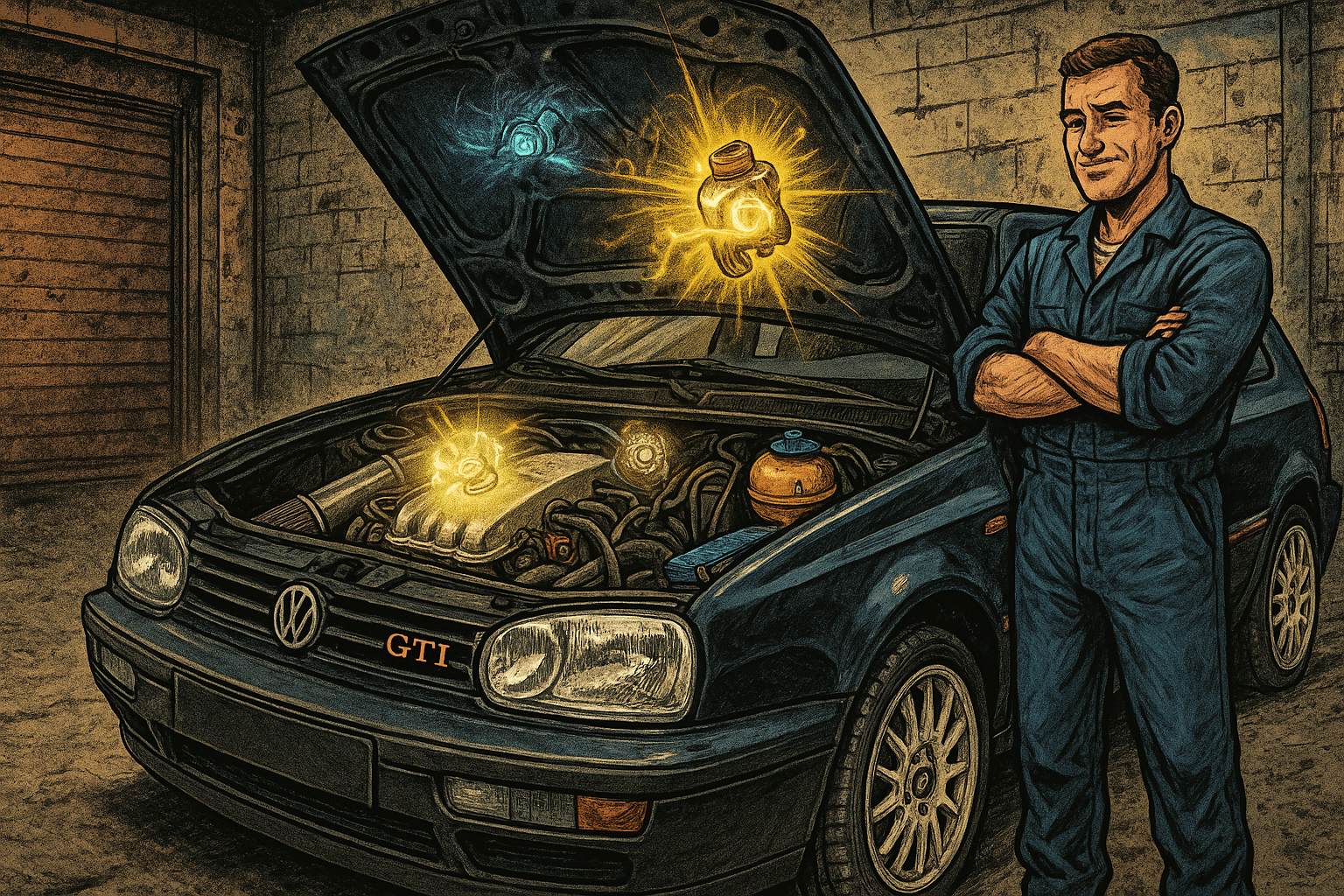
When you own a GTI that is almost 30 years old, you learn to notice the smallest changes in its behavior. That is how this chapter began, a slight fluctuation in idle, something that initially seemed harmless, until it turned into a traffic light nightmare.
While stopped, CirueloGTI’s engine started acting strange. The RPMs would go up and down without control, as if it had a rhythm of its own. Sometimes it would rev on its own, other times it would simply stall when braking or pressing the clutch. On top of that, the car had lost power. It no longer pulled like a real GTI. It felt dull, disconnected, soulless.
Then, almost as if fate decided to show some mercy, I ran into Alexis Sevilla at a food court. An old friend, and thankfully, an excellent mechanic. Even better, Alexis used to own a GTI Mk3 just like mine, and he knows these cars inside and out.
I explained the symptoms. He listened, gave that half smile of someone who already knows what is going on, and said, bring it to the shop, that car has something living inside it, but we will get it out.
I took it in, and the moment he heard it running, he said without hesitation, that IAC is dead.
The IAC, or Idle Air Control valve, regulates airflow when you are not on the throttle. When it fails, the engine no longer knows how much air and fuel mixture it needs, and it starts acting possessed. Mine was clearly at the end of its life.
We replaced it with a new unit, and instantly the idle came back to life, stable, firm, no surprises. Like an exorcism had just taken place.
But that was only the tip of the iceberg.
During the inspection, Alexis found that the oxygen sensor was also failing. This sensor tells the ECU how much fuel to inject based on incoming air. When it goes bad, fuel consumption increases, power drops, and throttle response suffers.
We replaced it with a new Bosch sensor, and just like that, the engine started breathing better and running more efficiently.
While checking everything else, an issue was also found in the engine control unit. The ECU had intermittent sensor reading errors, caused by worn terminals and poor connections. The module required repair, including terminal replacement and a full inspection of the wiring.
This is when you realize that many so called ghost issues do not come from a single failed part, but from a combination of small problems that slowly build up and create chaos.
To finish things properly, Alexis suggested what he calls an engine ABC, a complete inspection protocol.
- Deep cleaning of the throttle body.
- Inspection of all critical sensors.
- Vacuum leak checks.
- Connector and wiring harness inspection.
- Idle and fuel mixture calibration.
- Basic mapping review and response adjustments.
This ABC is not a repair by itself, but a way to ensure that the entire system is aligned and working as it should. Think of it as a holistic tune up for an engine that has lived through years of neglect.
The Result
CirueloGTI came back to life.
The idle is stable. The engine sounds cleaner. Throttle response is back. It no longer stalls at intersections, and it no longer feels like a dark force is taking control when the car is stopped. Even the exhaust note changed, it now sounds more balanced, more confident.
After all of this, the lesson was clear. When a GTI starts acting crazy, it is rarely a single cause. More often, it is a chain of aging sensors, connectors, and valves slowly failing over time, and only a trained and patient eye like Alexis’ can put all the pieces together.
And that is how I survived the idle demon.